https://publications.iom.int/fr/books/fatal-journeys-volume-3-part-2-improving-data-missing-migrants
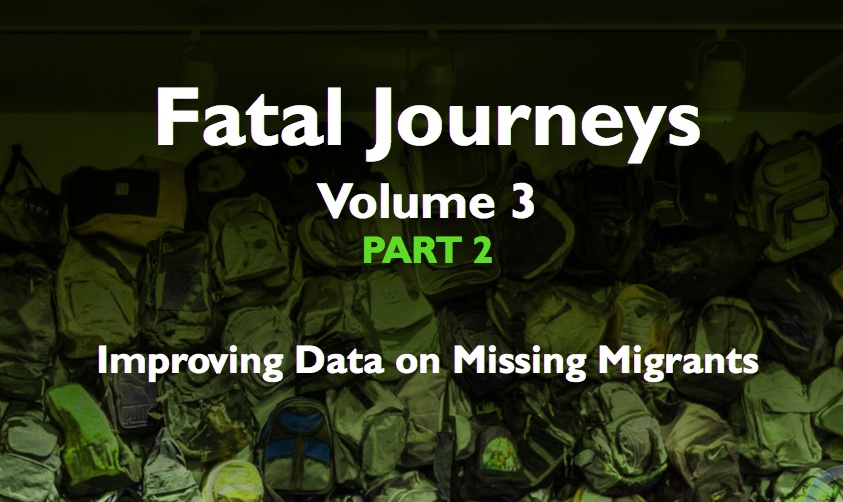
Since 2014, the International Organization for Migration has recorded the deaths of nearly 25,000 migrants. This figure is a significant indicator of the human toll of unsafe migration, yet fails to capture the true number of people who have died or gone missing during migration. This report, the third volume in the Fatal Journeys series, focuses on improving data on migrant fatalities. It is published in two parts. Part 1 critically examines the existing and potential sources of data on missing migrants. Part 2 focuses on six key regions across the world, discussing the regional data challenges and context of migrant deaths and disappearances.
The second part of Fatal Journeys Volume 3 makes five key recommendations that emerge from the comparison of regions and innovative methodologies discussed in both parts of the report:
(a) Make better use of administrative data: Local, national and regional authorities that collect data on missing migrants should publish these data wherever and whenever possible, in accordance with data protection standards. These authorities should also cooperate to standardize data collection to improve the possibilities for data comparison and cross-checking.
(b) Promote survey-based data collection: In areas where few institutions collect data on missing migrants, or where access is an issue, surveys can provide new data on deaths and the risks people face during migration.
© Explore new technologies: The use of modern technologies and data sources, such as “big data”, piloted in some regions, could be expanded to improve the availability and completeness of data on migrant fatalities.
(d) Work with families and civil society: The needs of families of missing migrants should be a central concern in all stages of data collection and identification processes. Data collection efforts led by family and civil society groups should be encouraged through collaboration with other actors.
(e) Improve data sharing: Across the world, data on missing migrants are fragmented and not shared effectively. Data sharing and cooperation between actors working on the issue of missing migrants should be promoted.
- Foreword
- Acknowledgements
- List of figures
- List of maps
- List of text boxes
- Executive summary
- Introduction
- Chapter 1– The Middle East and North Africa by Tara Brian
- 1.1. Introduction
- 1.2. Middle East
- 1.3. North Africa
- Chapter 2 — Sub-Saharan Africa by Chris Horwood
- 2.1. Introduction: Migration trends and policy context
- 2.2. Risks and vulnerabilities of sub-Saharan African migrants moving through and out of the region
- 2.3. Existing data sources in the sub-Saharan Africa region
- 2.4. Responding to data collection challenges
- Chapter 3 — Asia-Pacific by Sharon Pickering and Rebecca Powell
- 3.1. Introduction
- 3.2. Risks migrants and refugees face in the Asia-Pacific
- 3.3. Assessment of available data in the Asia-Pacific
- 3.4. What do the available data show?
- 3.4. How to address the data collection challenges in the Asia-Pacific
- Chapter 4 — Central America by John Doering-White, Amelia Frank-Vitale and Jason De León
- 4.1. Introduction
- 4.2. South
- 4.3. Central
- 4.4. North
- 4.5. Conclusion
- 4.6. Action points for change
- Chapter 5 — South America by Vanina Modolo
- 5.1. Introduction
- 5.2. Migration trends and policy context
- 5.3. Risks faced by migrants in South America: Recent changes
- 5.4. Migrant fatalities and data collection in the region
- 5.5. Final remarks and recommendations
- Chapter 6 — Europe and the Mediterranean by Ignacio Urquijo Sanchez and Julia Black
- 6.1. Background: Recent migration trends and policy context
- 6.2. Risks undertaken during migration to and within Europe
- 6.3. Assessment of available data
- 6.4. Action points

UNODC — GLOBAL REPORT ON TRAFFICKING IN PERSONS 2022
[et_pb_section fb_built=“1” _builder_version=“4.19…
CNDCH — Publication de l’évaluation du 2e plan d’action national contre la traite des êtres humains
[et_pb_section fb_built=“1” _builder_version=“4.16…
OIM — Fatal Journeys — VOLUME 1 — Tracking Lives Lost during Migration (Edited by Tara Brian and Frank Laczko) — 2015
https://publications.iom.int/fr/books/fatal-journe…
OIM — Migrant Smuggling Data and Research: A global review of the emerging evidence base VOLUME 1 — 2016
http://publications.iom.int/books/migrant-smugglin…
OIM — Migrant Smuggling Data and Research: A global review of the emerging evidence base Volume 2 — 2018
http://publications.iom.int/books/migrant-smugglin…
Humanitarian debate: Law, policy, action — Migration and displacement
[gview file=“https://christusliberat.org/journal/wp…